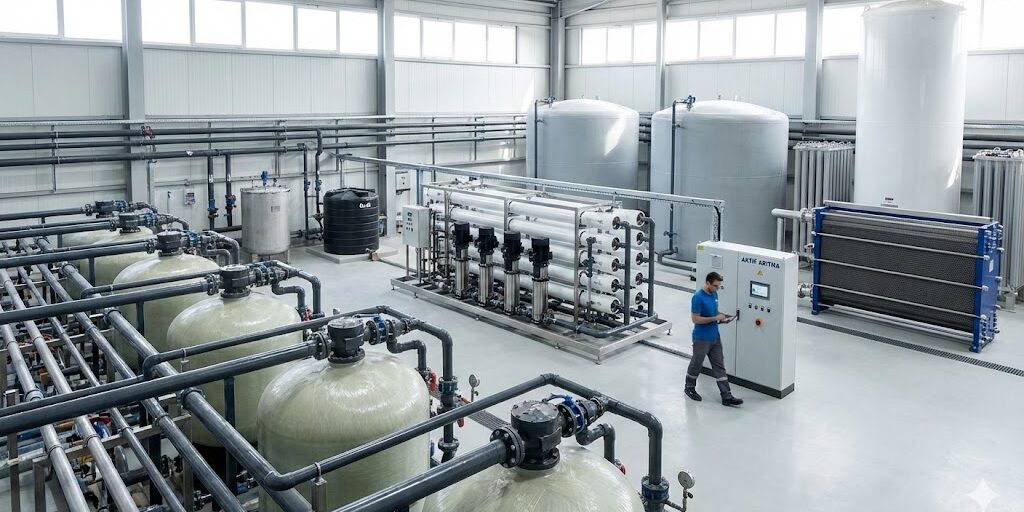
Industrial Water Treatment Processes serve as the cornerstone of modern manufacturing, ensuring that the water used in various production cycles meets the rigorous quality standards required for efficiency, safety, and environmental compliance. At AAT, we specialize in the engineering, manufacturing, and installation of complex systems that handle everything from raw river water treatment to the production of high-purity deionized water. Understanding the intricacies of industrial water management is essential for facilities that rely on pressure vessels, heat exchangers, and storage tanks to maintain their operational integrity.
The Significance of High-Quality Water in Industry
Water is rarely used in its natural state within an industrial setting. Whether it is used for cooling, steam generation, or as a direct ingredient in chemical production, the presence of minerals, gases, and organic contaminants can lead to catastrophic equipment failure. AAT provides comprehensive solutions that integrate equipment manufacturing with advanced chemical engineering to protect these assets. The role of Industrial Water Treatment Processes is to mitigate risks such as scaling, corrosion, and biological fouling, which are the primary enemies of industrial pressure tanks and heat exchangers.
Industrial Water Treatment Processes: A Comprehensive Overview
To achieve the desired water quality, a series of interconnected stages must be implemented. These Industrial Water Treatment Processes vary depending on the source water—be it municipal, well, or river water treatment systems—and the specific requirements of the end-use application.
1. Primary Filtration: Sand and Carbon Filters
The first line of defense in any water treatment plant is mechanical and adsorption filtration. Sand filters are utilized to remove suspended solids and turbidity from the water. By using graded layers of silica sand or anthracite, these systems ensure that larger particles do not reach sensitive downstream equipment like Reverse Osmosis (RO) systems.
Following sediment removal, carbon filters play a vital role in removing chlorine, organic compounds, and odors. For industries where the final product must be free of chemical tastes or smells, such as the food and beverage sector, AAT designs heavy-duty pressure tanks specifically for high-capacity activated carbon media.
2. Water Softening Systems
Hard water, characterized by high levels of calcium and magnesium, is a leading cause of scale buildup in boilers and heat exchangers. Water softening systems utilize ion-exchange resins to replace hard minerals with sodium ions. This process is crucial for extending the lifespan of atmospheric storage tanks and preventing the clogging of narrow pipes within an industrial facility.
3. Advanced Membrane Technologies: Reverse Osmosis (RO)
When high-level purification is required, Reverse Osmosis (RO) systems are the industry standard. This process forces water through a semi-permeable membrane, leaving behind up to 99% of dissolved salts and contaminants. AAT integrates these systems into robust frames, often coupled with pressure vessels designed to withstand the high operating pressures required for efficient desalination and purification.
Specialized Equipment and Tank Manufacturing
The physical housing of treatment processes is just as important as the chemical reactions taking place inside them. AAT is a leader in the production of pressurized tanks and cryogenic storage tanks.
Pressure Vessels and Storage Solutions
In industrial water cycles, water must often be stored or processed under high pressure. Our pressure vessels are engineered to meet international safety standards, ensuring they can handle the stresses of continuous operation. Furthermore, atmospheric storage tanks are essential for holding treated water before it is distributed throughout a plant.
Cryogenic Storage and Gas Management
Beyond water, many industrial processes require the management of liquefied gases. Cryogenic storage tanks are specialized containers designed to hold materials at extremely low temperatures. In facilities where gas storage is integrated with water treatment—such as in certain chemical synthesis plants—having a single partner like AAT to handle both equipment manufacturing and system integration provides a significant logistical advantage.
Heat Exchangers and Vaporizers
Temperature control is a critical component of many water treatment cycles. Heat exchangers allow for the efficient transfer of thermal energy between fluids, while vaporizers are used to convert liquefied gases back into their gaseous state for use in the facility. These components are often part of the broader Industrial Water Treatment Processes used to pre-heat feed water or cool down treated effluents.
High-Purity Water: Demineralization and EDI
For industries like electronics and pharmaceuticals, standard softened water is insufficient. Demineralization systems use a combination of cation and anion exchange resins to remove virtually all ionized minerals.
Electrodeionization (EDI) Systems
Electro deionization systems represent the pinnacle of water purification technology. By combining ion exchange with electricity, EDI systems provide continuous deionization without the need for hazardous chemical regeneration. AAT implements these systems for clients who require ultra-pure water for high-precision manufacturing.
Degasifier Systems
Dissolved gases like oxygen and carbon dioxide can be highly corrosive to industrial pressure tanks. Degasifier systems are employed to strip these gases from the water, usually through vacuum or forced-draft towers, ensuring the longevity of the entire plumbing and storage infrastructure.
Environmental Stewardship: Wastewater and Recovery
Modern Industrial Water Treatment Processes are not just about intake; they are also about what leaves the factory. Wastewater treatment systems are now a legal and ethical requirement for most industries.
Recovery Systems and Zero Liquid Discharge
AAT focuses heavily on recovery systems (Geri Kazanım). By treating wastewater to a high enough standard, it can be cycled back into the facility for non-critical uses, such as cooling or cleaning. This reduces the overall water footprint of the company and lowers operational costs.
Flue Gas and Odor Removal
Industrial impact isn’t limited to water. Flue gas treatment (Baca Gazı Arıtma) and odor removal (Koku Giderimi) systems are essential for maintaining air quality standards. These systems often use scrubbers that involve water-based chemical reactions, linking air purification directly to the facility’s water treatment infrastructure.
Disinfection and Safety: Ultraviolet (UV) Systems
Ensuring that water is free of pathogens is critical, especially in the medical and food industries. Ultraviolet (UV) disinfection systems provide a chemical-free way to neutralize bacteria and viruses. By passing water through a chamber containing high-intensity UV lamps, the DNA of microorganisms is disrupted, rendering them harmless without changing the chemical composition of the industrial water.
Engineering, Maintenance, and Rental Services
The lifecycle of a water treatment plant extends far beyond the initial installation. AAT provides a holistic approach through consulting & project engineering, ensuring that the system is tailored to the specific chemical profile of the source water.
Service, Maintenance, and Operation
Regular service maintenance and operation (Servis Bakım İşletme) are vital to prevent downtime. A failure in an Industrial Water Treatment Processes sequence can halt an entire production line. Our teams provide scheduled inspections and emergency repairs for all components, from sand filters to Reverse Osmosis membranes.
Rental Treatment Solutions
For temporary projects, construction sites, or seasonal capacity increases, rental treatment (Kiralık Arıtma) services offer a flexible alternative to permanent capital expenditure. These mobile units are fully equipped with AAT technology and can be deployed rapidly to meet immediate water needs.
Technical Specifications of Tank Manufacturing
As a firm specializing in basınçlı kaplar (pressure vessels) and buharlaştırıcılar (vaporizers), we understand that the material science behind the equipment is as important as the filtration technology.
| Equipment Type | Common Materials | Key Function in Water Treatment |
| Pressure Tanks | Carbon Steel / Stainless Steel | Housing for filters and ion exchange resins. |
| Atmospheric Tanks | GRP / PE / Stainless Steel | Storage of raw or treated process water. |
| Heat Exchangers | Titanium / Stainless Steel | Temperature regulation of process fluids. |
| Cryogenic Tanks | Double-walled Vacuum Insulated | Storage of liquid nitrogen or oxygen for gas-reliant processes. |
Why Choose AAT?
In the competitive landscape of Industrial Water Treatment Processes, AAT stands out by offering an end-to-end solution. We are not just equipment suppliers; we are engineering partners. Our ability to manufacture our own pressure vessels and tanks while simultaneously designing the chemical treatment stages allows for a level of customization and quality control that few can match.
From the initial river water treatment to the final UV disinfection, every step of the process is optimized for energy efficiency and long-term durability. Whether you need a simple kum filtre (sand filter) or a complex demineralizasyon plant, our expertise ensures that your facility operates at peak performance.
Conclusion
The evolution of Industrial Water Treatment Processes has allowed modern industry to grow while minimizing its environmental impact. By utilizing advanced technologies like Ters Ozmoz (RO), EDI, and robust equipment imalatı (manufacturing), companies can secure their water supply and protect their mechanical assets. AAT continues to lead this field, providing the consultancy, engineering, and maintenance services required to keep the wheels of industry turning smoothly. As we look to the future, the integration of water recovery systems and smarter gas storage solutions will remain at the heart of sustainable industrial growth.