Water Treatment with Carbon Filter stands as one of the most fundamental and efficient methods in today’s industrial and domestic sectors for enhancing water quality, removing organic pollutants, and ensuring safe drinking water. Water is not only the source of life but also the most critical raw material for industry. However, raw water sources containing chlorine, unpleasant odors, taste disturbances, and various chemical compounds can make water unusable for direct consumption. This is exactly where the specialized water treatment solutions of AAT come into play.
What is a Carbon Filter and How Does It Work?
At the heart of Water Treatment with Carbon Filter systems lies a highly porous material with an extensively expanded surface area called “activated carbon.” Activated carbon is typically derived from organic materials such as wood, coal, or coconut shells, processed through “activation” at high temperatures in an oxygen-free environment. This process creates millions of microscopic pores within the carbon.
This porous structure allows pollutants in the water to stick to the surface. This physical and chemical process is known as “adsorption.” Carbon filter systems remove chlorine and chlorine compounds (such as chloramine) at rates up to 99%, while trapping organic substances that cause bad odors and tastes. Within industrial treatment plants, this stage is generally positioned after sand filters and before Reverse Osmosis (RO) systems.
Technical Components of Water Treatment with Carbon Filter Systems
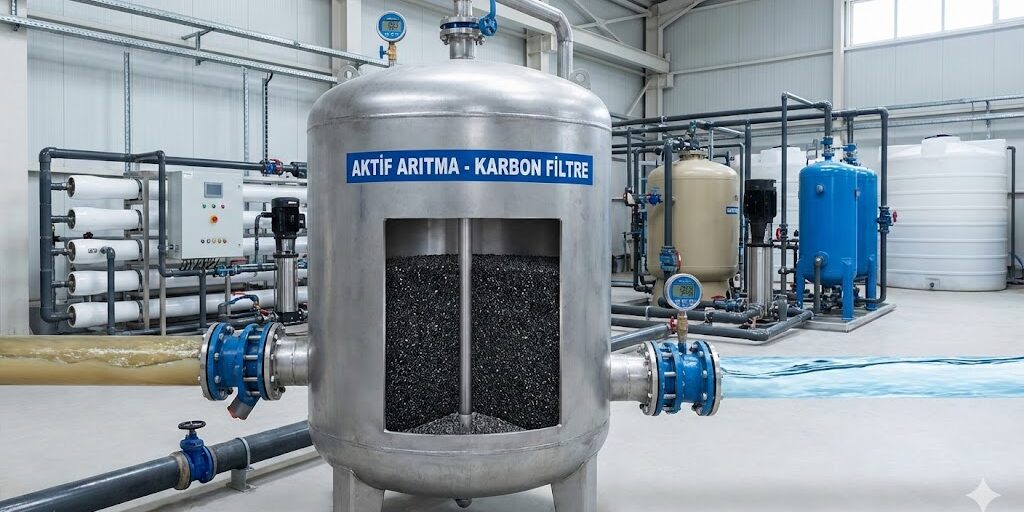
Efficiency in a treatment plant depends not only on the quality of the carbon used but also on the design of the pressure tank that houses it. AAT plays a critical role in this process through the production of high-quality pressure vessels and atmospheric storage tanks.
A typical system consists of these main components:
Filter Tank: A high-pressure resistant body containing the carbon mineral.
Control Valve / Surface Piping: The system that manages water inlet-outlet and backwash processes.
Diffuser Systems: Ensures equal distribution of water within the tank, utilizing every point of the carbon bed efficiently.
Activated Carbon Mineral: The filter material (granular or block) selected based on specific needs.
The Chemistry of Adsorption in Water Treatment with Carbon Filter
The adsorption occurring during Water Treatment with Carbon Filter is not merely a straining process. Thanks to Van der Waals forces, pollutant molecules are attracted to the carbon surface. Specifically, volatile organic compounds (VOCs), pesticides, industrial waste residues, and detergent remnants are successfully captured by the carbon.
Key parameters determining the efficiency of activated carbon include:
Iodine Number: Indicates the porosity and adsorption capacity of the carbon.
Particle Size: Affects the resistance water encounters and the contact time.
Empty Bed Contact Time (EBCT): How long the water remains in contact with the carbon. AAT engineers calculate the most suitable tank volume and carbon quantity based on water flow rate and pollution load.
Industrial Applications of Carbon Filters
In many industrial sectors, the purity of water directly impacts product quality. The systems established by AAT utilize Water Treatment with Carbon Filter technology in the following sectors:
1. Food and Beverage Industry
Water used in food production must be neutral in taste and odor. The reaction of chlorine with food ingredients spoils the product’s shelf life and flavor. The use of a carbon filter is a standard in this sector.
2. Textile and Dyehouse Systems
Organic substances in water used during dyeing processes can prevent dye from adhering to the fabric. We provide high efficiency in textile factories with our industrial water treatment solutions.
3. Power Plants and Heat Exchangers
Using carbon filters before water softening and demineralization systems prevents ion-exchange resins from being damaged by chlorine. It also reduces the risk of corrosion within evaporators and heat exchangers.
Relationship Between Pressure Tank Production and Carbon Filters
AAT is not just a system integrator but also an equipment manufacturing firm. The pressure tanks we produce for Water Treatment with Carbon Filter units are designed in accordance with long-term durability and safety standards (ASME, PED).
Material Selection: Tanks produced from carbon steel or stainless steel are protected against corrosion with internal epoxy or special rubber linings.
Precision Engineering: The design of internal diffusers prevents “dead zones,” ensuring every gram of carbon is functional.
Cryogenic and Atmospheric Storage: Our expertise in cryogenic storage tanks and gas storage enhances the durability and engineering precision of our treatment tanks.
Maintenance and Backwashing in Carbon Filter Systems
For Water Treatment with Carbon Filter systems to operate continuously and with high efficiency, regular “backwashing” is essential. Over time, sediments accumulating on the upper layers of the carbon bed restrict water flow and cause pressure drops.
The fully automated control systems installed by AAT initiate the backwash process by sensing pressure differences or via timed intervals. During this process, water enters from the bottom of the tank, lifting the carbon bed and sending accumulated debris to the drain line. However, it must be noted that when the adsorption capacity of the carbon is saturated, the mineral must be completely replaced. Our service maintenance and operation team determines the timing of this replacement through periodic checks to minimize system downtime.
Alternative and Complementary Systems
Water Treatment with Carbon Filter is usually not a standalone solution but part of a broader treatment chain.
Sand Filter and Carbon Filter Combination
Before reaching the carbon filter, water should pass through a sand filter system. This prevents coarse sediments from clogging the pores of the carbon.
Reverse Osmosis (RO) and Carbon Filter
Reverse Osmosis (RO) systems separate dissolved salts. However, RO membranes are extremely sensitive to chlorine. The carbon filter extends the life of RO membranes by capturing chlorine. This is one of the most common integrated solutions applied by AAT.
Ultraviolet Disinfection and Degasifiers
Since carbon filters trap organic matter, they can provide a ground for bacterial growth. Therefore, adding ultraviolet disinfection systems to the system outlet is recommended. For removing dissolved gases, degasifier systems come into play.
Professional Solutions with AAT
Choosing a partner rather than just an equipment supplier is critical for companies investing in Water Treatment with Carbon Filter. AAT develops customized projects based on your water analysis through consulting & project engineering services.
Our services include:
River Water Treatment Systems: Cleaning high organic loads in surface waters with carbon filters.
Wastewater Treatment Systems and Recovery: Reusing treated wastewater in the process after carbon filtration.
Rental Treatment: Modular carbon filter and RO system rental options for temporary needs.
Flue Gas Treatment and Odor Control: Utilizing activated carbon technology not just for water, but also for air pollution control.
Things to Consider When Choosing a Carbon Filter
The most important factor to consider when purchasing a Water Treatment with Carbon Filter unit is “surface velocity.” In industrial systems, if the water velocity through the filter is too high, there isn’t enough time for pollutants to stick to the carbon surface. AAT engineers guarantee maximum efficiency by calculating the ideal velocity (m/h) based on your water’s chemical structure.
Furthermore, the origin and activation level of the activated carbon are vital. Coconut-based carbons are ideal for drinking water and odor removal due to their micropore structure, while coal-based carbons are more successful in color removal and capturing large organic molecules.
Sustainability and Eco-Friendly Approach
Water Treatment with Carbon Filter technology is an environmentally friendly method as it reduces chemical usage. It optimizes the need for disinfection methods like chlorination and allows water to be recycled back into industry. Thanks to recovery systems, businesses reduce water costs while natural water resources are protected.
AAT offers water softening systems, electrodeionization (EDI) systems, and advanced treatment technologies integrated with carbon filter solutions for a sustainable future. Every pressure tank and filter unit is built to increase energy efficiency and reduce waste.
Conclusion
Water Treatment with Carbon Filter is an indispensable necessity for modern industry. These systems, which fundamentally change water quality, provide great economic advantages to enterprises when combined with correct engineering and quality equipment. As AAT, we continue to provide the most reliable solutions to our customers with our wide product range including pressure vessels, evaporators and heat exchangers, and our deep experience in the treatment sector.
Whether it is river water treatment or sensitive demineralization systems, the Water Treatment with Carbon Filter unit at the beginning of every project is your strongest shield for water safety and process continuity. Our expert staff is with you at every step, from service maintenance and operation to the equipment manufacturing stage.