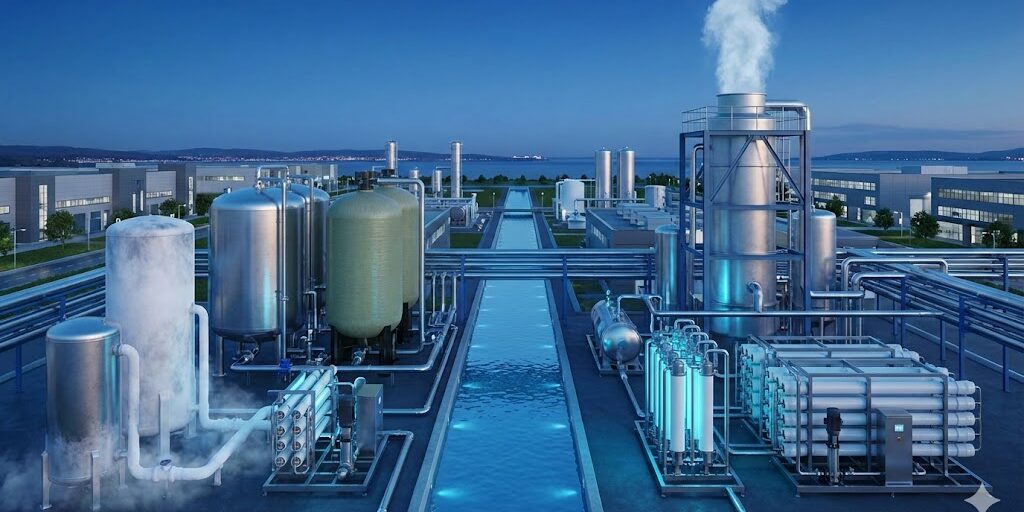
Global industrial production paradigms are undergoing a radical transformation in the second quarter of the 21st century. Water is no longer viewed merely as a utility input or a simple coolant; it is now recognized as a critical raw material that directly impacts production continuity, product quality, and operational costs. At the heart of this new industrial ecosystem lie the pressure vessels, cryogenic storage systems, and integrated treatment processes that form the core of “AAT’s” operations. This report aims to serve as a comprehensive reference for industry professionals by deeply examining the engineering foundations, thermodynamic processes, material science, and operational dynamics of Industrial Water Treatment Plants (IWTP).
The scope of this report spans a wide spectrum, ranging from the molecular-level purification of raw water to the storage of process gases at $-196^\circ C$; from the mechanical durability of high-pressure vessels to the evaporation technologies required to achieve Zero Liquid Discharge (ZLD) targets. The analysis is synthesized from field data in industrial hubs like Kocaeli, current academic literature, and technological trends. The objective is not only to define the technology but to demonstrate how these technologies merge with the “AAT” vision to transform into industrial efficiency.
1. Engineering Foundations and Process Design of Industrial Water Treatment Plants
Industrial water treatment is a multidisciplinary process at the intersection of chemical engineering, microbiology, hydraulics, and material science, extending far beyond simple filtration. Plant design begins with the characterization of raw water and continues with the optimization of unit operations required to reach the target product water quality (e.g., conductivity < 0.1 µS/cm, TOC < 10 ppb).
1.1. Water Quality Parameters and Industrial Criticality Analysis
Due to its properties as a universal solvent, water is never found in a pure state in nature. In industrial processes, every milligram of impurity can lead to massive costs and production downtime.
1.1.1. Effects of Physical and Chemical Contaminants
Total Suspended Solids (TSS), turbidity, and colloidal matter can clog sensitive process equipment and deposit on heat transfer surfaces, reducing energy efficiency. Advanced technologies such as ceramic membrane filtration minimize this risk by filtering particles down to 3 microns. However, the primary danger often lies in dissolved forms. Hardness caused by calcium and magnesium ions leads to scaling in boilers and pipelines, while chloride and sulfate ions accelerate corrosion. Specifically, silica ($SiO_2$) can form glassy layers on high-pressure turbine blades, disrupting aerodynamics and proving extremely difficult to clean.
1.1.2. Microbiological Control and Biofilm Management
Biofilm is the most insidious enemy of industrial water systems. Bacteria adhere to surfaces and secrete a polysaccharide matrix that hinders heat transfer and facilitates Microbiologically Influenced Corrosion (MIC). In the pharmaceutical and food industries, the microbiological quality of water is synonymous with product safety. Ultraviolet (UV) disinfection and ozonation systems are utilized to keep this biological load under control.
1.2. Process Flow Diagram (PFD) and System Integration
The PFD of an industrial water treatment plant consists of sequential and complementary units from the raw water source to the discharge point. This integration is where the engineering expertise of firms like “AAT” is showcased.
Pre-treatment: Consists of coarse screens, sand filters, and cartridge filters to protect sensitive downstream membranes.
Primary Treatment: Removal of suspended solids and heavy metals via chemical precipitation and flocculation.
Secondary (Biological) Treatment: Removal of organic pollution (BOD/COD) with the help of microorganisms. This is where the efficiency of cryogenic oxygen systems comes into play.
Tertiary (Advanced) Treatment: Water recovery or ultra-purification through membrane processes (UF, NF, RO), ion exchange, and evaporation.
2. Pressure Vessel Technologies: Design, Manufacturing, and Hydraulic Dynamics
Pressure vessels are the “silent giants” of water treatment plants. Often seen merely as storage tools, they are critical components that maintain hydraulic balance, dampen pressure surges, and host chemical reactions.
2.1. Mechanical Design Principles of Pressure Vessels
The design of a pressure vessel relies on a complex combination of material yield strength, operating pressure, temperature, and corrosion allowance.
2.1.1. Stress Analysis and Safety Factors
In a cylindrical tank under internal pressure, hoop stress is twice the longitudinal stress. Therefore, the longitudinal weld seams are the most critical areas. Designers size walls according to ASME Section VIII or EN 13445 standards, considering the joint efficiency factor. In tanks where weld seams are 100% inspected via Radiographic Testing (RT), this factor is taken as 1.0, whereas it can drop to 0.7 in uninspected tanks.
2.1.2. Material Selection and Corrosion Resistance
Carbon Steel (ST-37/ST-52): Widely used for large-volume raw water tanks due to cost-effectiveness. Internal surfaces must be coated with epoxy, ebonite, or galvanization to prevent corrosion.
Stainless Steel (AISI 304/316L): Standard for food, pharma, and pure water lines. The 316L grade is more resistant to pitting corrosion due to its molybdenum content. It is mandatory for the inner shells of cryogenic tanks as it does not become brittle at low temperatures.
FRP (Fiber Reinforced Plastic): Used in seawater desalination and chemical dosing tanks due to total corrosion resistance.
3. Cryogenic Storage and the Role of Industrial Gases
In modern, large-scale plants, cryogenic (ultra-low temperature) gas technologies are indispensable. These systems play a game-changing role in enhancing biological activity in wastewater treatment and in Advanced Oxidation Processes (AOP).
3.1. Cryogenic Tank Technology and Thermodynamic Isolation
Cryogenic tanks store liquefied gases (Oxygen $-183^\circ C$, Nitrogen $-196^\circ C$, Argon $-186^\circ C$). When a substance is liquefied, its volume shrinks hundreds of times (approx. 1/860 for Oxygen), allowing for economical storage.
Vacuum Technology: The “annular space” between the inner and outer tanks is kept under high vacuum ($10^{-3}$ mbar) to prevent convective heat transfer. “Super Insulation” (multi-layer aluminum foil/glass fiber) is used to block radiation.
Safety Systems: To prevent BLEVE (Boiling Liquid Expanding Vapor Explosion) risks, tanks are equipped with Pressure Building Units (PBU), Economizers, and dual safety valves with bursting discs.
4. Advanced Membrane Technologies and Filtration Spectrum
The heart of industrial water treatment is membrane technology, which separates contaminants using physical barriers.
4.1. Reverse Osmosis (RO)
The most common and critical technology. A semi-permeable membrane allows water molecules to pass while blocking dissolved salts and heavy metals. It relies on applying high pressure to overcome osmotic pressure.
Membrane Housings: RO membranes operate at pressures between 20 and 80 bar, housed in special pressure vessels made of FRP or stainless steel.
4.2. Electro-Deionization (EDI)
For power plants or chip manufacturing requiring Ultra-Pure Water, RO permeate is insufficient. EDI uses electric current and ion-selective membranes to remove the final trace ions without the need for chemical regeneration (acid/caustic).
5. Zero Liquid Discharge (ZLD) and Evaporation Systems
Tightening environmental regulations are pushing facilities toward ZLD, where no wastewater is discharged, and all water is recovered.
5.1. Mechanical Vapor Recompression (MVR)
Traditional evaporation is energy-intensive. MVR technology uses a compressor to increase the pressure and temperature of the evaporated steam, which then heats the incoming wastewater. This reduces operating costs by up to 80% compared to conventional systems.
6. Data Analysis and Comparative Tables
Table 1: Comparative Analysis of Membrane Technologies
| Technology | Pore Size / Cut-off | Primary Contaminants Removed | Operating Pressure (Bar) |
| Microfiltration (MF) | 0.1 – 10 µm | TSS, Bacteria, Oil emulsions | 1 – 3 |
| Ultrafiltration (UF) | 0.01 – 0.1 µm | Viruses, Colloids, Proteins | 2 – 5 |
| Nanofiltration (NF) | 0.001 – 0.01 µm | Divalent ions ($Ca^{2+}, Mg^{2+}$), Color | 5 – 15 |
| Reverse Osmosis (RO) | < 0.001 µm | Monovalent ions ($Na^+, Cl^-$), All minerals | 10 – 80 |
| EDI | Ion Selective | Trace ions (Silica, Boron) | < 1 (Water pressure) |
Table 2: Pressure Vessel Material Performance Matrix
| Material Type | Corrosion Resistance | Pressure Strength | Ideal Use Case |
| Carbon Steel (Coated) | Low (depends on coating) | Very High | Large sand filters, Hydrophore tanks |
| Stainless Steel (304L) | Medium/High | High | Food process tanks, Cryogenic inner shells |
| Stainless Steel (316L) | Very High | High | Pharma tanks, Seawater lines |
| FRP (Composite) | Excellent (Inert) | Medium | Seawater pre-treatment, Chemical dosing |
7. Plant Operation, Automation, and Maintenance
Modern plants are synchronized machines. Their efficiency depends on SCADA and PLC systems rather than manual intervention.
Autonomous Decisions: If the differential pressure ($\Delta P$) in an RO system increases, the SCADA automatically triggers a Clean-In-Place (CIP) cycle or shuts down to prevent membrane damage.
Predictive Maintenance: Data analytics allow for forecasting when a membrane will expire or when a pump requires service, preventing unplanned downtime.
8. Economic Perspective and Conclusion
While industrial water treatment investments have high CAPEX, they quickly pay for themselves through OPEX savings.
Water Recovery: Can reduce water bills by up to 70%.
Energy Efficiency: Preventing 1 mm of scale build-up can save 10% in energy consumption.
Equipment Longevity: Proper treatment protects millions of dollars’ worth of infrastructure from corrosion.
Future Vision:
“AAT” is not just a supplier but a solution partner. With expertise in cryogenic storage, pressure vessel manufacturing, and membrane technologies, it provides integrated solutions. Water is the lifeblood of industry; “AAT” provides the technology that ensures that life is sustainable.